Open Banking
All modules
Import a bank statement from a CSV or CAMT.053 file
Open Banking · 9 of 15 · 3 min read
With manual import you load the transactions of a bank account from a file downloaded from home banking, in CSV or CAMT.053 format. It is for accounts that are not connected to the bank, for example the Bank (BNK1) account, or for those whose consent has expired, such as Events and Deposits Account (CRD1).
When to use manual import
The Manual import button is in the action bar of each account's page. Its behavior depends on how the account receives transactions.
- If the account has the Manual only badge, such as
Bank, import is the way to get the transactions in. Alternatively you can connect the account to the bank. - If the account has the Reauthorize badge, such as
Events and Deposits Account, the button is available. Use it to load a missing period while you reconnect the account. - If the account has the Auto-sync active badge, such as
Main Current Account, the button is disabled. On hover Disabled while auto-sync is active appears: transactions arrive from the bank, and a file uploaded by hand would overlap the downloaded ones. To update the account use sync.
An account that has no transactions yet shows the message No movements yet — connect the bank or import a file in the list. The two options are connecting to the bank and importing a file.
Importing a file
Upload the file from the account page.
- Go to Invoices › Banking.
- Open the account, for example
Bank. - Press Manual import. The Import CSV or CAMT.053 file panel opens.
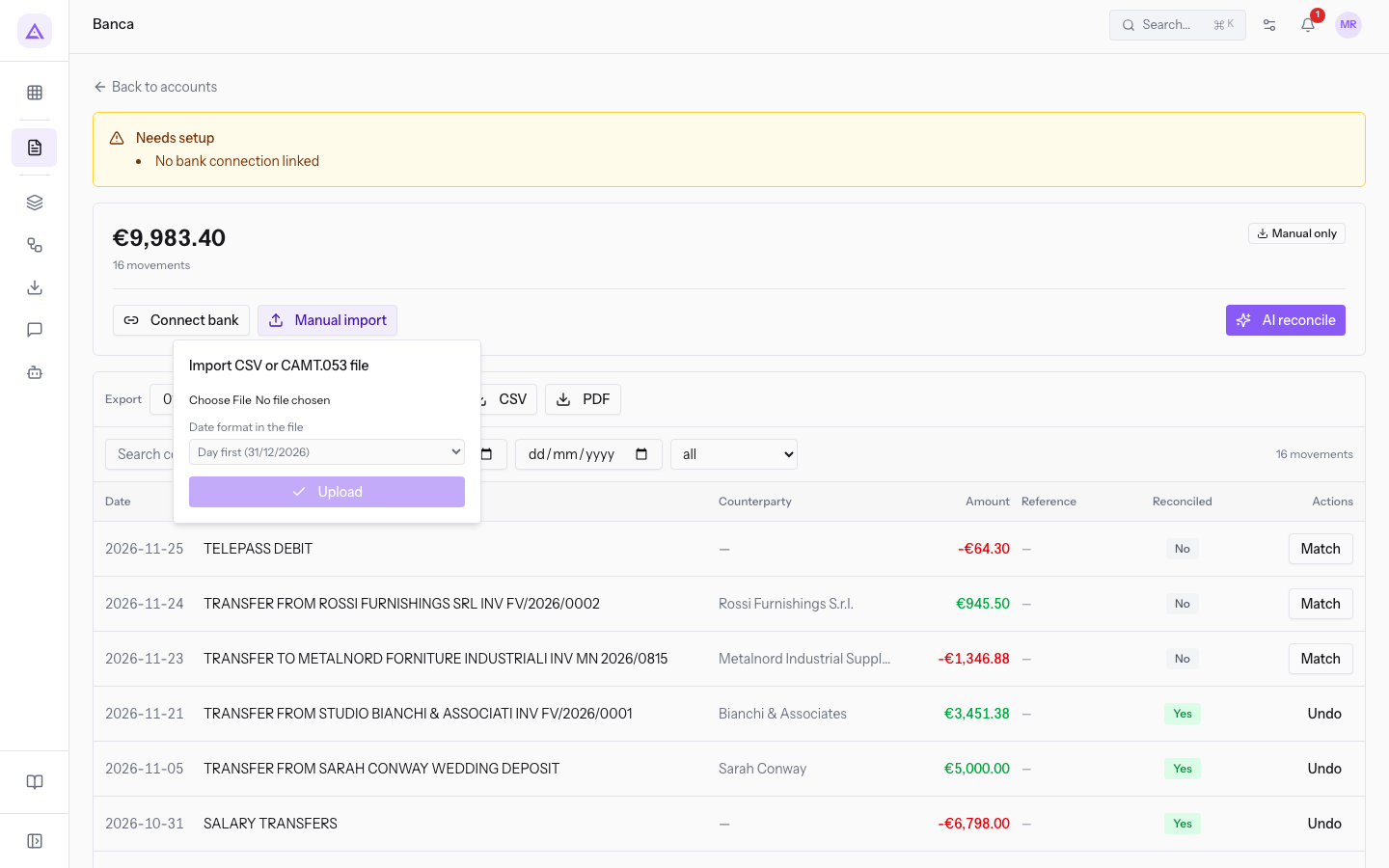
- Choose the CSV or CAMT.053 file downloaded from the bank.
- In Date format in the file choose how the dates are written in the file.
- Press Upload.
The fields in the panel:
- Date format in the file: the order of day and month in the dates of the file. The suggested value is Day first (31/12/2026).
- Day first (31/12/2026): for dates written the Italian way, with the day first.
- Month first (12/31/2026): for dates written with the month first, as in the files of some foreign banks.
Important: check the format before uploading. With the wrong order a date such as 05/03/2026 is read as a different day.
If all rows are read, the Statement imported message appears. The transactions show in the list on the account page and you can reconcile them.
Warnings after import
If the file was uploaded but something does not add up, the Statement imported with warnings message appears. The warnings stay below the action bar on the account page.
N row(s) were skipped: their date or amount could not be read.: some rows of the file were not imported because the date or amount cannot be read. N is replaced by the number of rows. Check that you chose the right Date format in the file and that the rows have an amount.The imported lines do not reach the closing balance the file declares (off by N). The file may be truncated.: the sum of the imported rows does not reach the closing balance written in the file. N is replaced by the difference. Usually part of the period is missing from the file: download the bank statement again for the full period.
Note: a balance that does not match must be clarified before reconciling. For connected bank accounts see Understand why the bank balance doesn't match the transactions.
See it on your company, not on a slide deck.
In 30 minutes we map the software you use today.We show you how much work and how much margin Archimedes gives back.
Show me on my business →What industry are you in?
One tap — it lets us prepare the demo around your world.
What tools do you use today?
Pick the ones you recognise — or just type them. It helps us show you how they migrate.
Last step: your details.
We reply within one working day — and right after, if you like, you pick the demo slot yourself.
We couldn't send your request. Try again, or write to us at [email protected].
By sending, you agree to your data being processed so we can get back to you about the demo. Privacy notice.
Preview form — nothing is sent from this page.
Want to schedule the demo now?
Your call: book the slot you prefer yourself, or we'll call you to arrange it.
Live availability, 30 minutes, instant confirmation. The calendar opens in a new tab.
Lock in your slot ↗We'll get back to you within one working day — and we'll join the call already knowing your world.
The calendar is open in another tab: pick a slot and the demo is booked. Can't see it? Reopen it ↗
Preview page: nothing was sent.
Our calendar is live: take the slot that suits you and the demo is booked. 30 minutes, instant confirmation, no waiting.
Lock in your slot ↗