Manufacturing
All modules
Manufacturing
Manufacturing · 1 of 15 · 5 min read
The Manufacturing module turns warehouse components into finished products. Bills of materials define what a product needs, manufacturing orders plan and record production, and work orders track each operation on the work centers.
This page presents the module's elements, its main screens, and its links with the other modules.
How it works
The module's work rests on four elements.
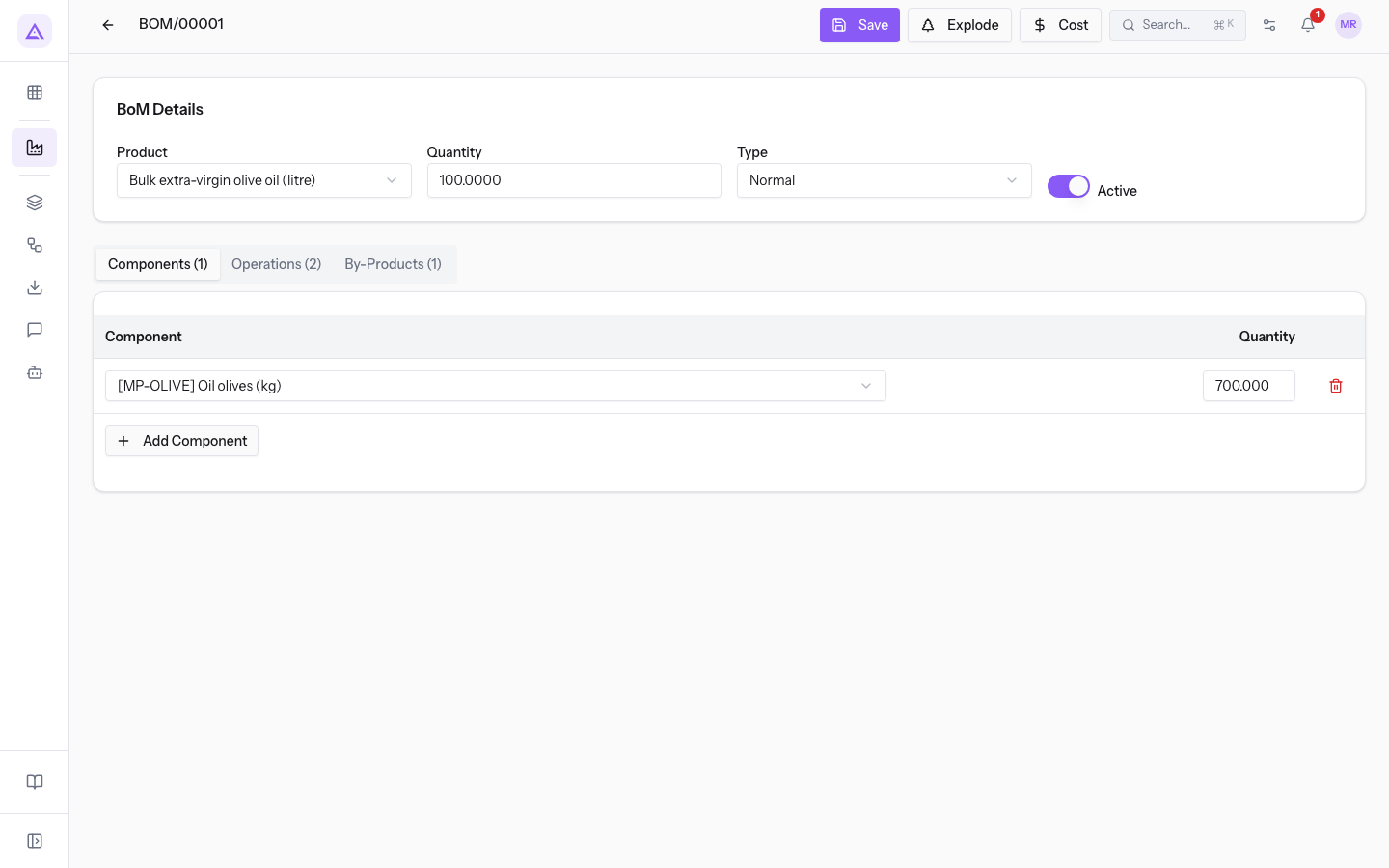
- Bill of materials: states which components and which quantities are needed for a given quantity of product. For example BOM/00001 for Bulk extra-virgin olive oil (litre): 100 l from 700 kg of olives. It can have by-products, such as Olive pomace (kg), and operations to perform on a work center, such as the Olive mill.
- Work center: the place or resource where an operation takes place. In the demo: Olive mill, Kitchen workshop, Bottling line, Basket packing bench.
- Manufacturing order: the order to produce a quantity of a product according to a bill of materials. The reference has the form MO/00005.
- Work order: one operation of the manufacturing order on a work center. It is started, paused and finished.
Bills of materials come in two types.
- If the product is manufactured, use a bill of materials of type Normal: when the order is confirmed it generates the component moves and the work orders.
- If the product is just a set of components, use a bill of materials of type Kit / Phantom, such as Bottle kit 0.5 l (glass, cap, label): it breaks the product down into bottle, cap and label and does not generate child orders.
Before you start: all users of the module can read bills of materials and work centers, but only the Manufacturing Manager group can create and edit them.
Statuses of a manufacturing order
A manufacturing order goes through these statuses.
- Draft: the order has just been created. It does not yet have components or work orders.
- Confirmed: confirming generates the moves of components, finished products and by-products, creates the work orders and reserves the available components.
- In Progress: production has started. The order reaches this status with Start, with the first recorded quantity, or with the start of a work order.
- Done: the components are consumed, finished products and by-products are loaded into stock, and the open work orders are closed.
- Cancelled: the order has been cancelled and the reservations are released. A completed order cannot be cancelled, because the stock has already been moved.
An order is late when it is confirmed or in progress and the planned start date has passed. In the demo, MO/00004 and MO/00009 are.
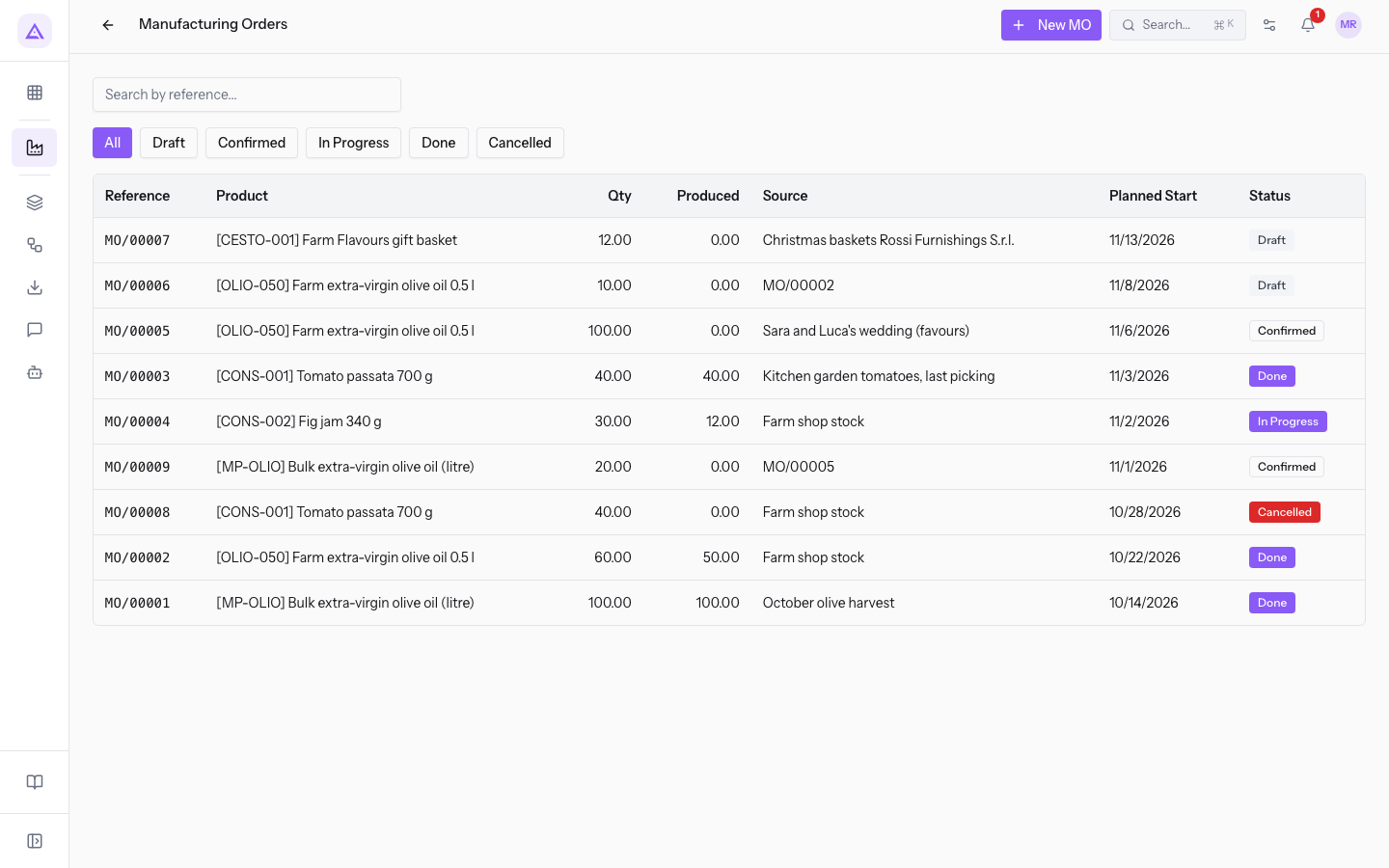
Important: if you complete an order after producing less than the planned quantity, components and by-products are consumed in proportion and the remainder goes into a new draft backorder. For example MO/00002 produced 50 bottles out of 60 and generated MO/00006.
The dashboard
Open the module from Manufacturing. The dashboard counts the orders by status, those completed today and those late, and lists the most recent orders. It also shows the production suggestions that come from the reorder rules.
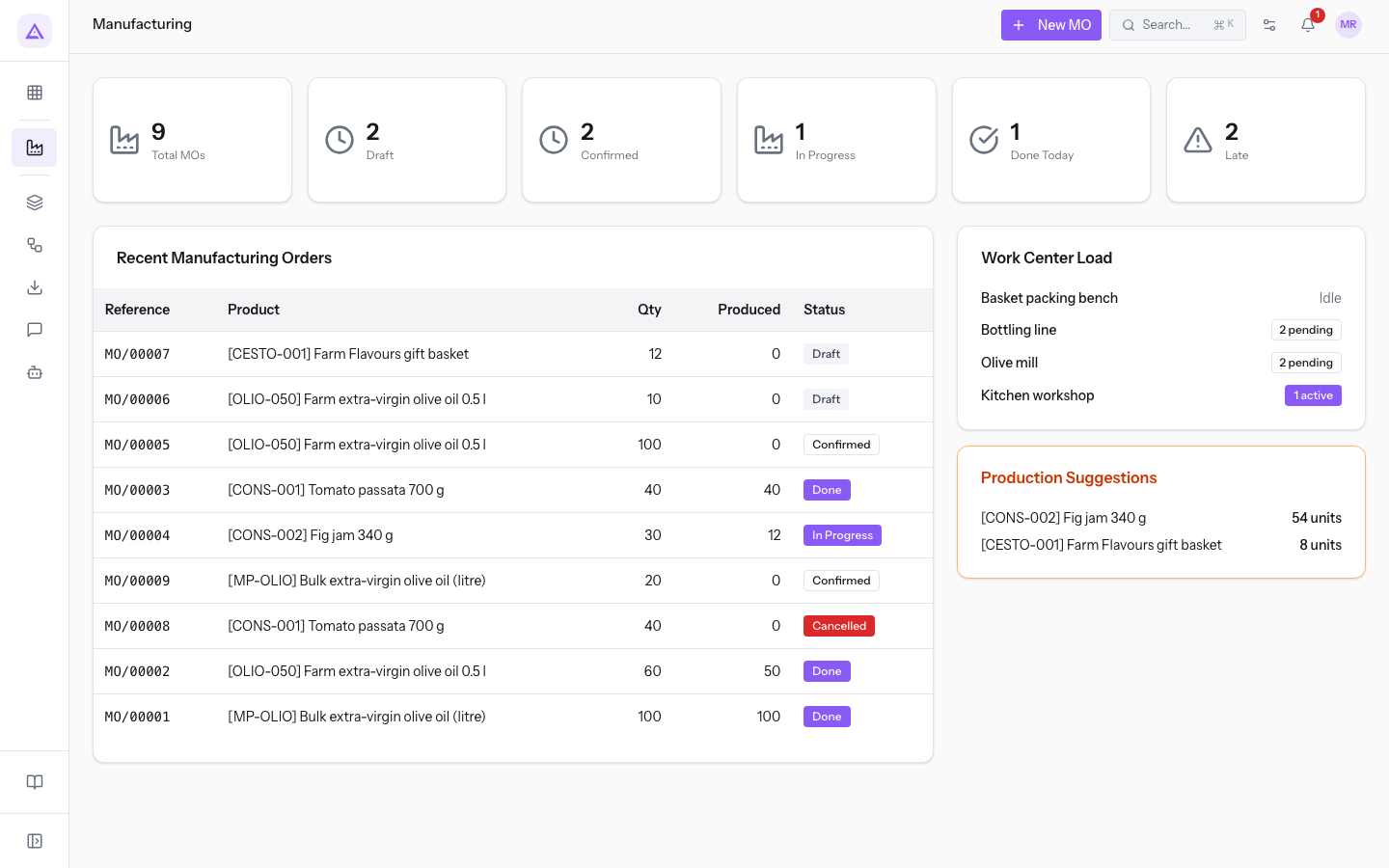
Suggestions appear when the free stock of a product with an active Normal bill of materials falls below the minimum of the reorder rule. They propose producing up to the rule's maximum, or up to the minimum if the rule has no maximum. In the demo they concern the Fig jam 340 g and the Farm Flavours gift basket.
Manufacturing orders
The Manufacturing Orders list shows all orders with reference, product, quantity, quantity produced, source document, planned start and status. You can filter it by status and search for an order by reference.
Open an order from the list to see its page, with the sections Details, Components, Finished Products, Work Orders and Notes. At the top are the status and the action buttons, such as Produce, Start, Mark Done and More actions. Each work order is started from its icon in the Actions column.
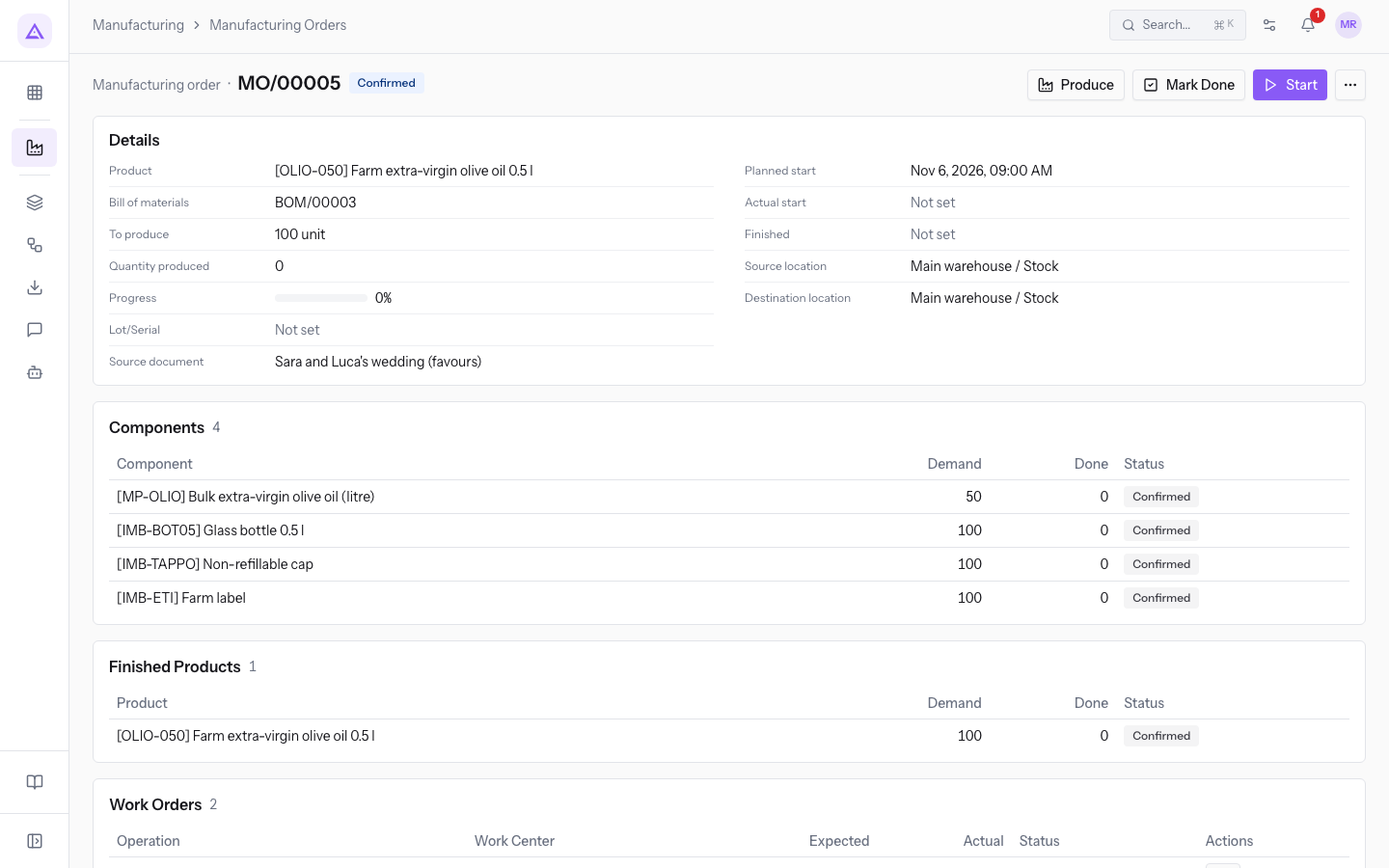
The Components section shows the status of each component, such as Confirmed, Reserved or Partially available. Check Availability adds the Component Availability section, with the columns Needed, Available and Shortage. For example MO/00005 requires 50 l of bulk oil and there are 30.
Note: on confirmation, if a component has its own normal bill of materials and the free stock is not enough, the system creates a child manufacturing order for the missing quantity. This is how MO/00009 was born, the milling of 20 l of bulk oil for MO/00005.
Bills of materials
The Bills of Materials list opens from Manufacturing › Settings › Bills of Materials. It shows for each bill of materials the reference, the product, the quantity, the number of components, the type and the status. You can filter it by type and search for a bill of materials by code.
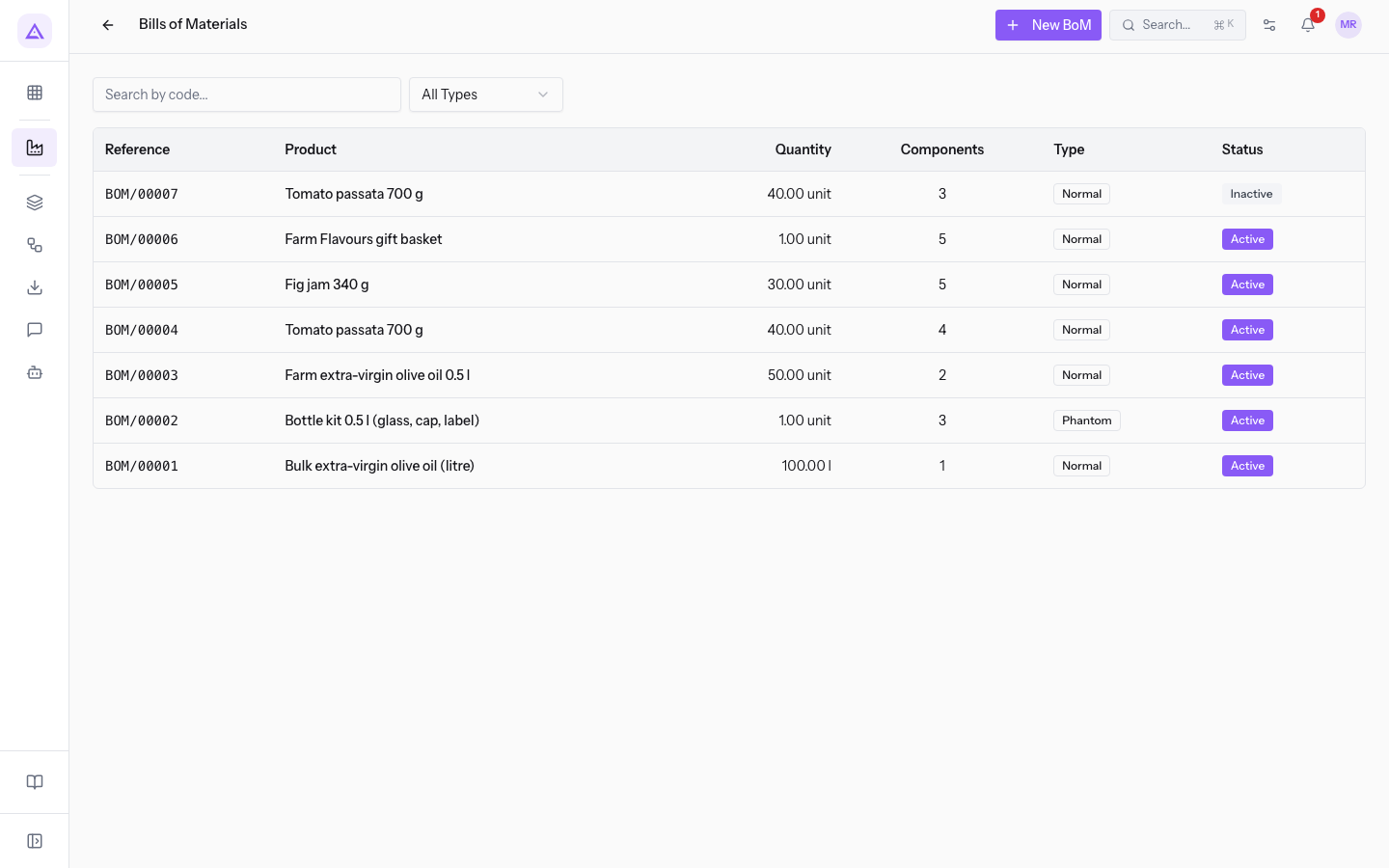
Open a bill of materials from the list to see its page, with the BoM Details panel and the views Components, Operations and By-Products. A bill of materials no longer in use is deactivated, such as BOM/00007, the old version of Tomato passata 700 g.
Links with the other modules
- Inventory: required. Components leave the source location and finished products enter the destination location. Stock levels, lots and reservations are those of the warehouse, and on completion the stock value is recorded. The reorder rules generate the production suggestions. The lot of the finished product is indicated when you record the production.
- Products: required. Finished products, components and by-products are catalog products.
- The Source document field links an order to what it comes from, for example the child order to its parent order.
See it on your company, not on a slide deck.
In 30 minutes we map the software you use today.We show you how much work and how much margin Archimedes gives back.
Show me on my business →What industry are you in?
One tap — it lets us prepare the demo around your world.
What tools do you use today?
Pick the ones you recognise — or just type them. It helps us show you how they migrate.
Last step: your details.
We reply within one working day — and right after, if you like, you pick the demo slot yourself.
We couldn't send your request. Try again, or write to us at [email protected].
By sending, you agree to your data being processed so we can get back to you about the demo. Privacy notice.
Preview form — nothing is sent from this page.
Want to schedule the demo now?
Your call: book the slot you prefer yourself, or we'll call you to arrange it.
Live availability, 30 minutes, instant confirmation. The calendar opens in a new tab.
Lock in your slot ↗We'll get back to you within one working day — and we'll join the call already knowing your world.
The calendar is open in another tab: pick a slot and the demo is booked. Can't see it? Reopen it ↗
Preview page: nothing was sent.
Our calendar is live: take the slot that suits you and the demo is booked. 30 minutes, instant confirmation, no waiting.
Lock in your slot ↗