Contracts
All modules
Prepare a draft: terms, cost items, clauses and text
Contracts · 6 of 15 · 6 min read
As long as a contract is in Draft you can change everything: terms, cost items, clauses and text. From this page you prepare the contract before sending it for signature.
A draft does not have a reference yet. In the line under the title, — appears in place of the reference, followed by the counterparty and the type.
When to work on the draft
With Send for signature the text is frozen and its fingerprint is recorded. While the contract is Awaiting signature, only the obligations remain editable. After signature, amount, expiry, notice and cost items are changed with an amendment. Clauses can no longer be changed.
- If the contract has a single amount with one cadence, fill in Amount and Billing cadence in the Edit contract window and do not add cost items.
- If the amount is made up of several lines, add cost items: they replace the header amount.
- If the signer must approve a clause separately, for example a cancellation penalty, turn on Needs specific approval.
- If you have corrected the template, press Refresh text to recreate the text before sending.
Opening the draft
In Contracts › All contracts press the row of the draft.
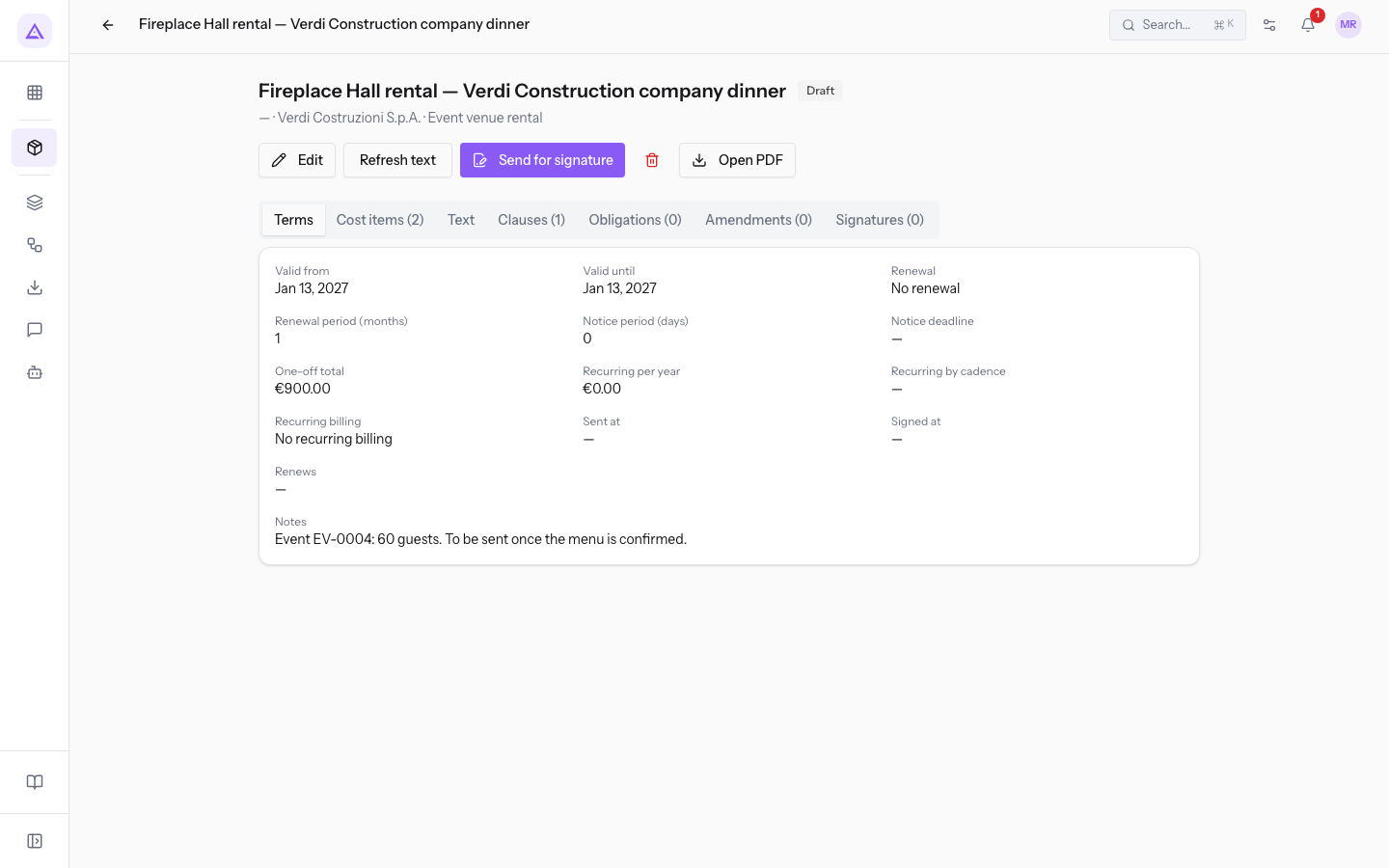
On a draft the page has the buttons Edit, Refresh text, Send for signature, Delete and Open PDF. The number in brackets next to a tab name counts the rows it contains. Delete removes the draft immediately: the message that appears lets you undo for a few seconds.
Important: Send for signature does not ask for confirmation: it freezes the text and sends a link by email to the signer. Press it only when the draft is complete.
Changing the terms
The Edit contract window collects the terms of the draft. It opens with Edit. Change the fields you need and press Save: the text is regenerated with the new data.
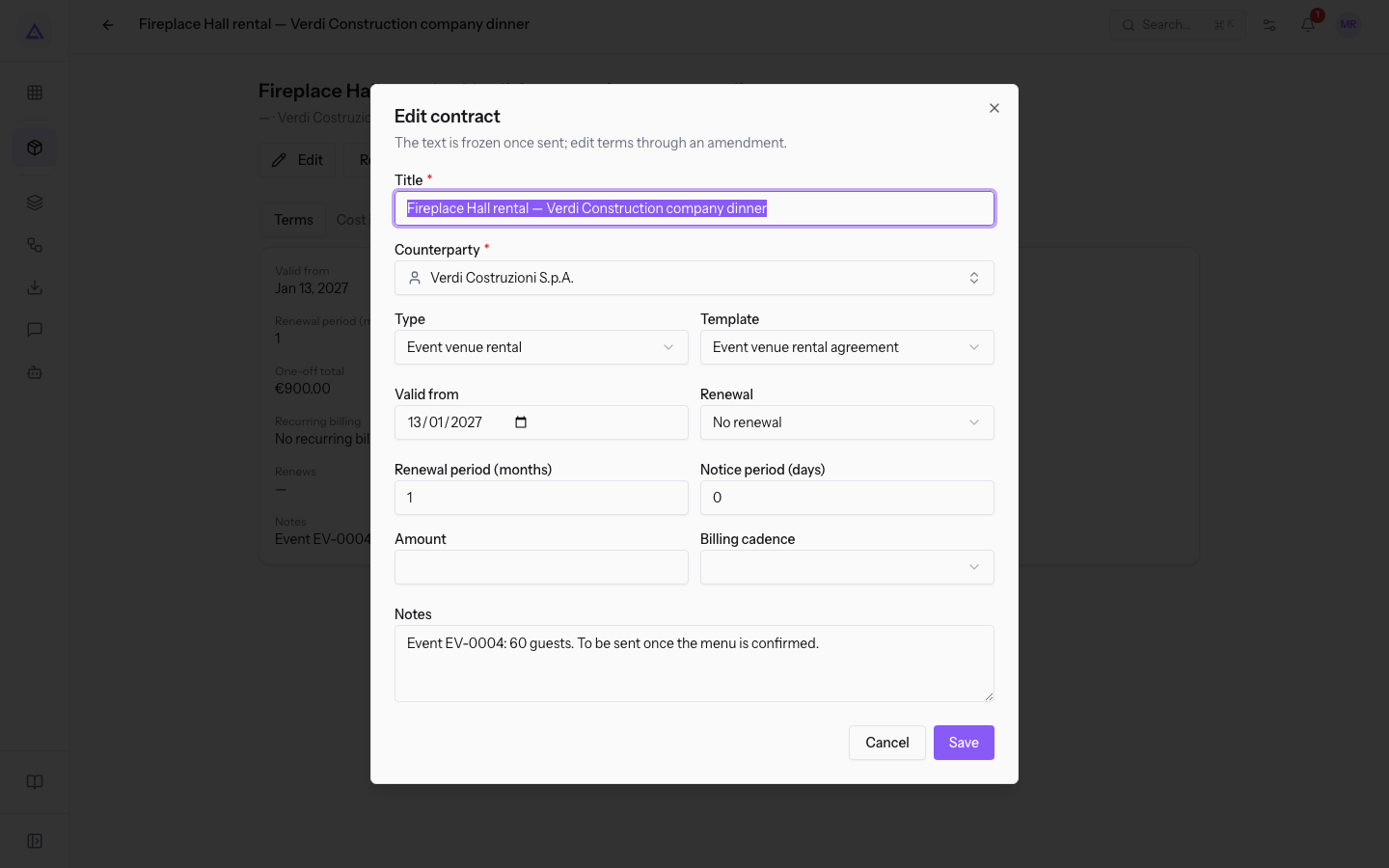
At the top of the window a notice reminds you that the text is frozen after sending and that after sending the terms are changed with an amendment.
- Title: the name of the contract. The field is required.
- Counterparty: the contact you are making the contract with. The field is required.
- Type: the nature of the contract. The options are — (no type) and the active types. When you choose a type, renewal, renewal period, notice and template take its default values.
- Template: the text with placeholders from which the contract text is built. The options are — and the active templates.
- Valid from: the date from which the contract is valid. Valid until is calculated when the contract is created: this window does not recalculate it.
- Renewal: what happens at expiry.
- No renewal: at expiry the contract becomes Expired.
- Tacit renewal: if no one gives notice of termination, the contract renews itself for the renewal period.
- Explicit renewal: at expiry the contract becomes Expired. To continue, a new contract to be signed is needed.
- Renewal period (months): the length of each renewal.
- Notice period (days): the days of notice for termination. The deadline for termination is the expiry minus these days.
- Amount: the single amount of the contract. It applies when the contract has no cost items.
- Billing cadence: how often the amount is billed. The options are Monthly, Quarterly, Yearly and Custom.
- Notes: internal notes.
Adding and removing cost items
Cost items split the contract amount into lines, each with a quantity and a price, either one-off or recurring.
- Open the Cost items tab.
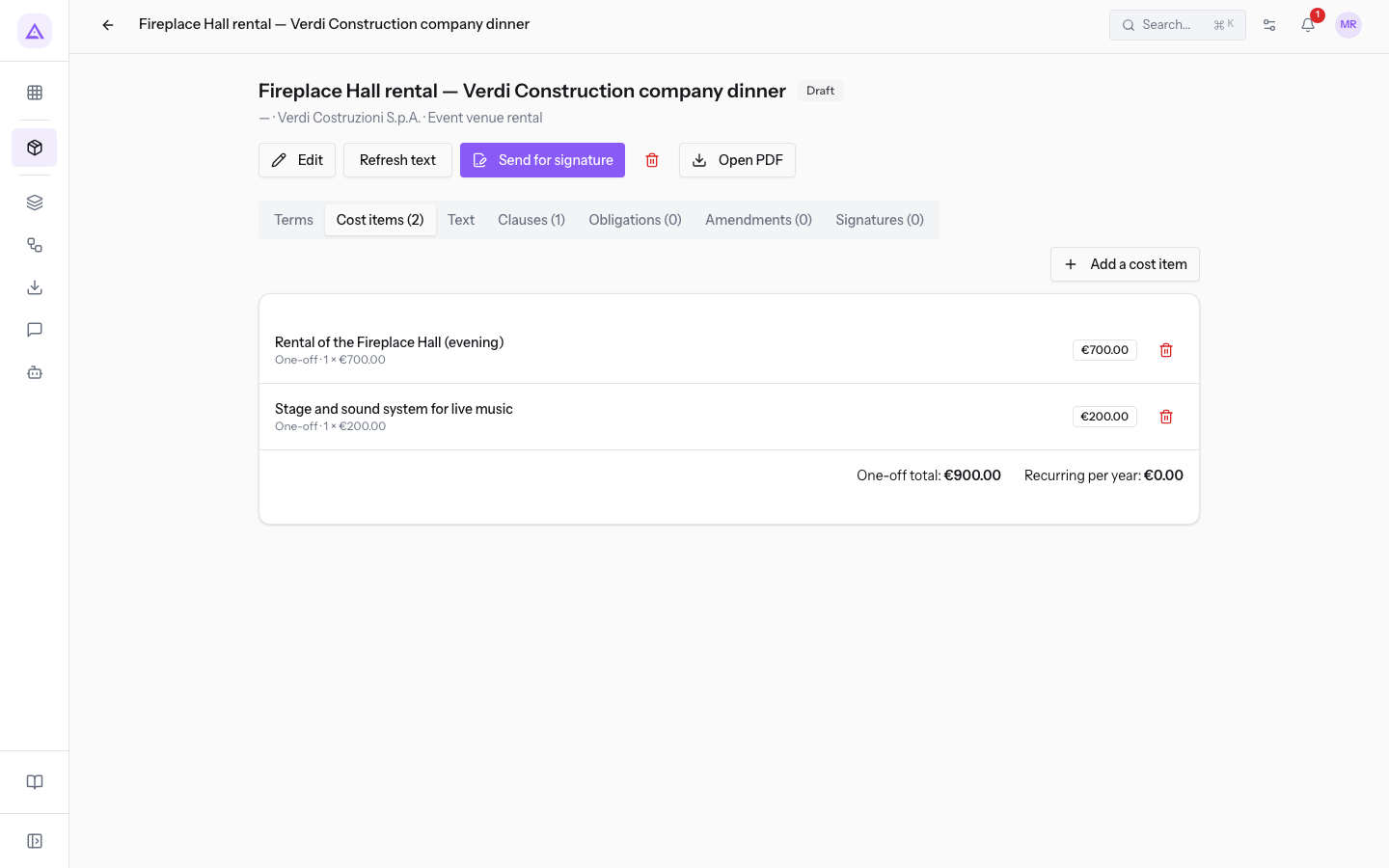
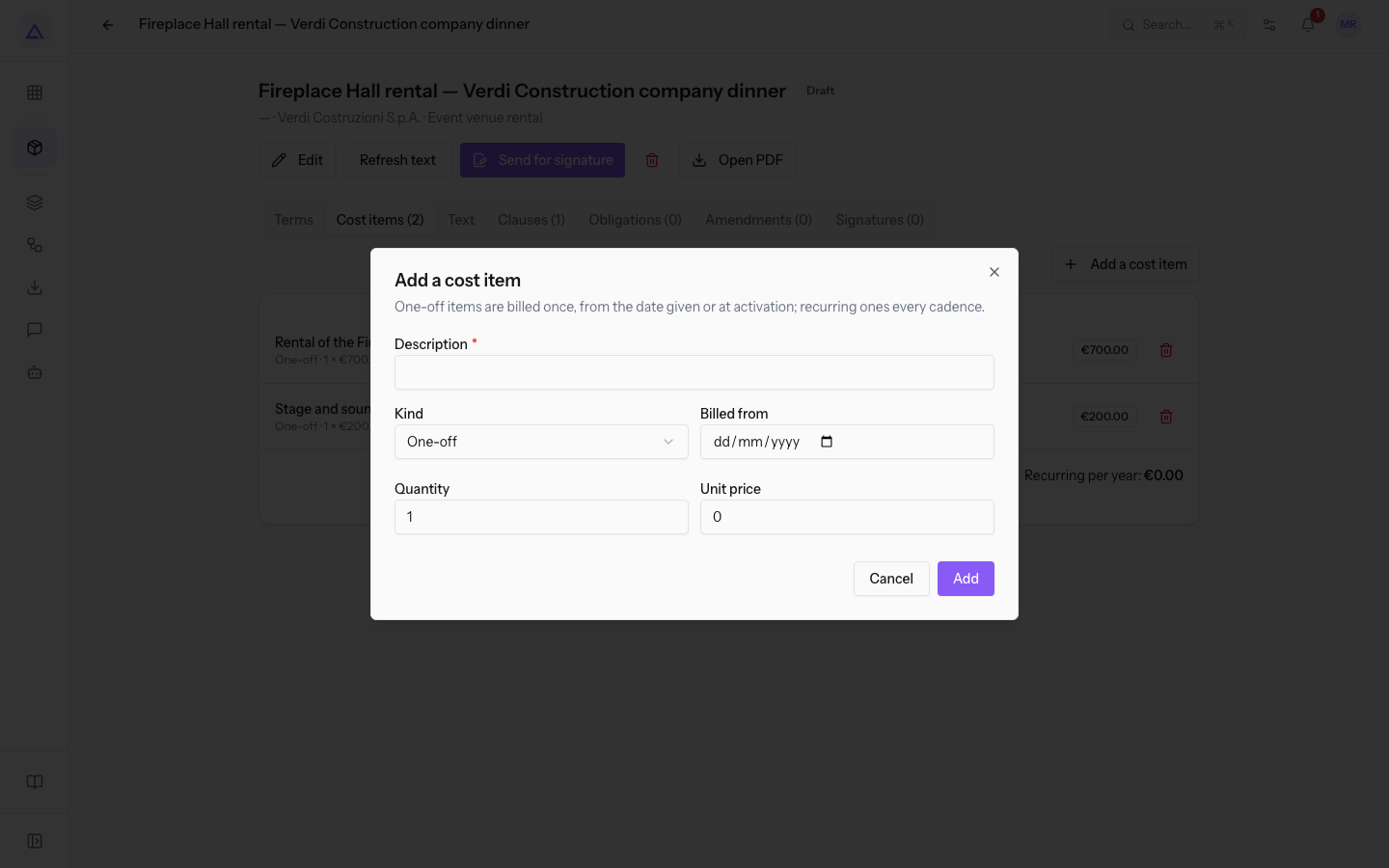
- Press Add a cost item and fill in the fields of the window.
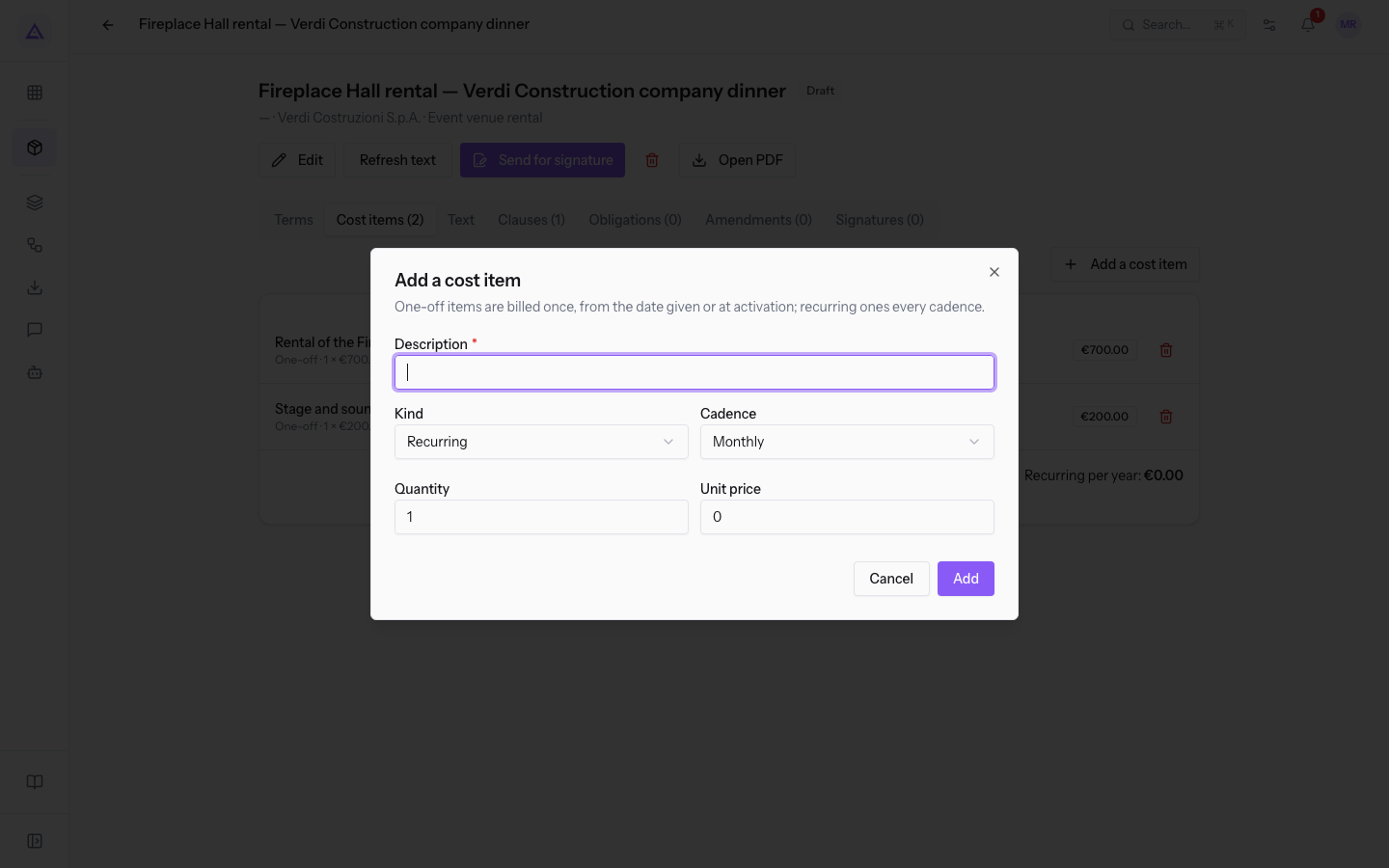
- Press Add. The message Cost items saved appears.
The window explains that one-off items are billed once, from the date given or on activation, and recurring ones at each cadence.
- Description: the name of the item. The field is required.
- Kind: how the item is billed. The default value is Recurring.
- One-off: the item is billed once. The field Billed from appears.
- Recurring: the item is billed at each cadence. The field Cadence appears.
- Billed from: the date from which to bill the one-off item. Without a date, the item is billed on activation of the contract. The field appears only for the kind One-off.
- Cadence: how often the recurring item is billed. The options are Monthly, Quarterly and Yearly. The field appears only for the kind Recurring.
- Quantity: the number of units. The default value is
1. - Unit price: the price of one unit. The default value is
0.
Below the rows the tab shows One-off total and Recurring per year. To remove an item, press the Remove icon, shaped like a trash can, on its row.
If the draft has no items, the tab shows No cost items: the header amount applies. In this case the Amount and Billing cadence fields of the terms apply.
Note: in a draft an added or removed item is saved immediately. On a signed contract the same change goes through an amendment.
Adding and removing clauses
Clauses are the parts of the contract to follow on their own: service level, penalty, price rule, exclusivity.
- Open the Clauses tab.
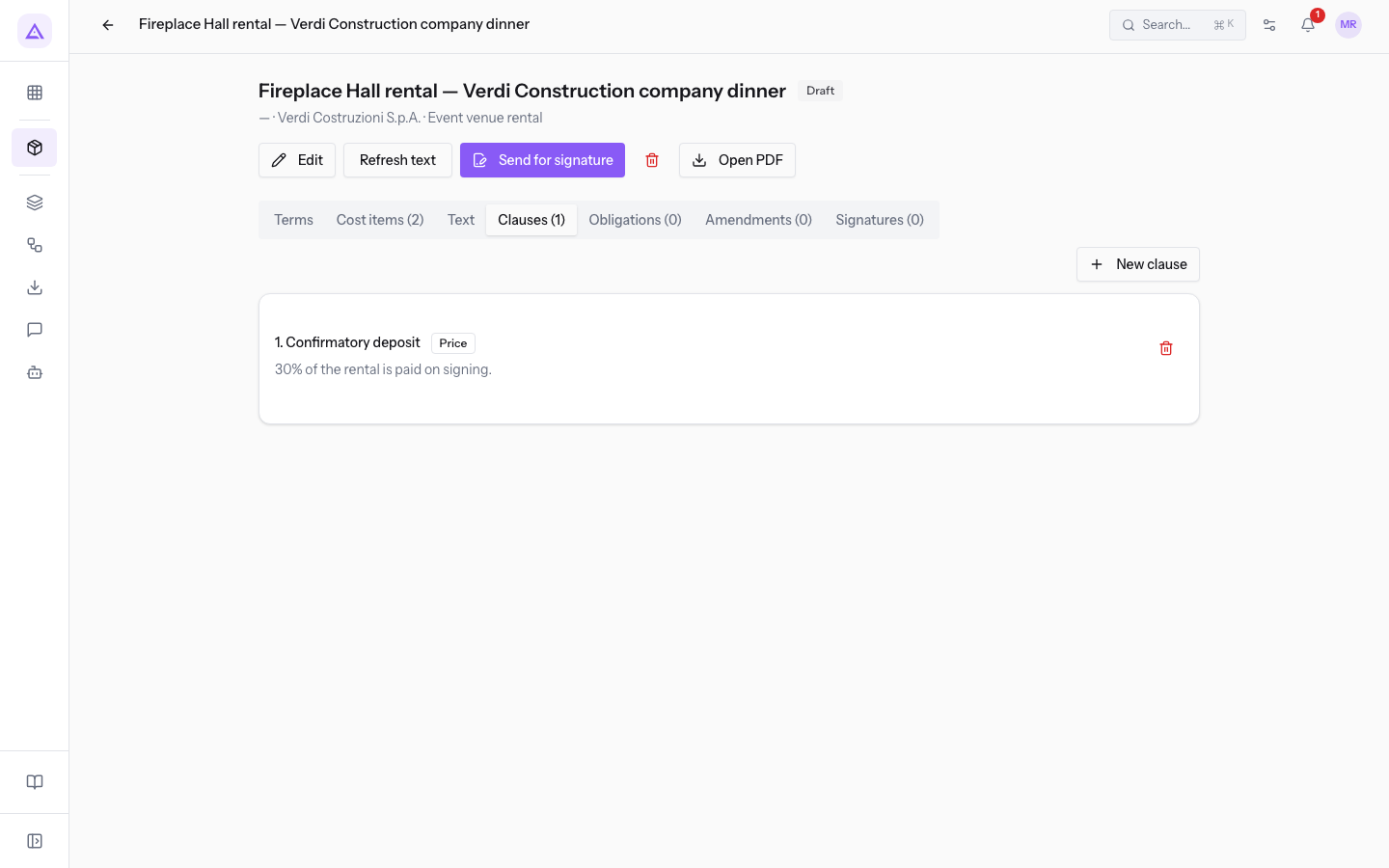
- Press New clause and fill in the fields of the window.
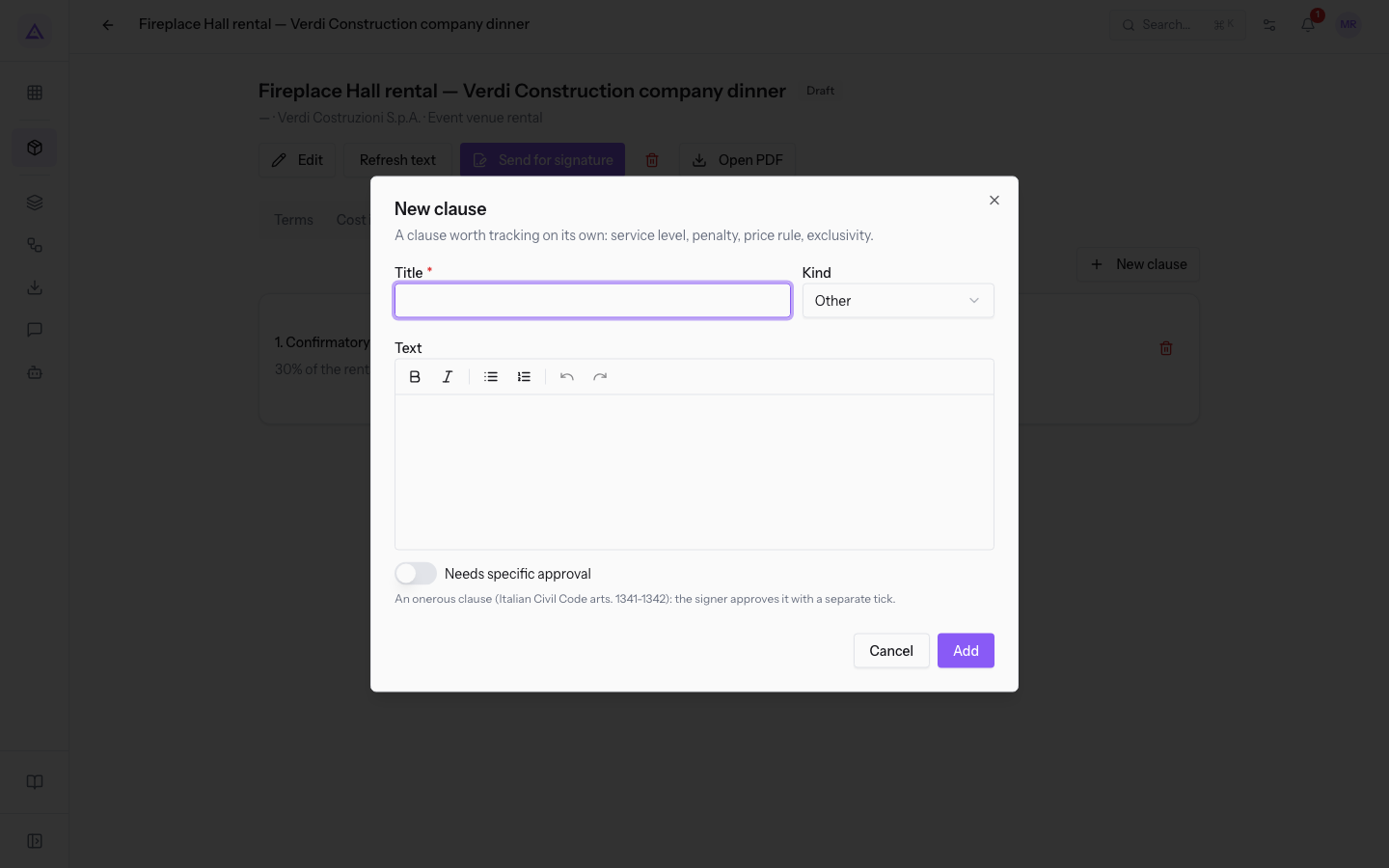
- Press Add.
- Title: the name of the clause, for example
Cancellation penalty. The field is required. - Kind: the nature of the clause. The default value is Other.
- Service level
- Penalty
- Price
- Exclusivity
- Confidentiality
- Termination
- Other
- Text: the content of the clause. The editor allows bold, italic, bulleted and numbered lists.
- Needs specific approval: marks the clause as an onerous clause (arts. 1341-1342 of the Italian Civil Code). The signer must approve it with a separate tick. The option is off by default.
From the email link or the portal the signer cannot sign without ticking every clause that requires specific approval. For a paper signature the approval is on the paper document.
To remove a clause, press the Remove icon, shaped like a trash can, on its row.
Important: clauses can only be changed in draft. After sending, the Clauses tab is read-only and an amendment does not change them.
Refreshing the text from the template
The contract text comes from the template: the placeholders are filled with the contract data. The Text tab shows the current text.
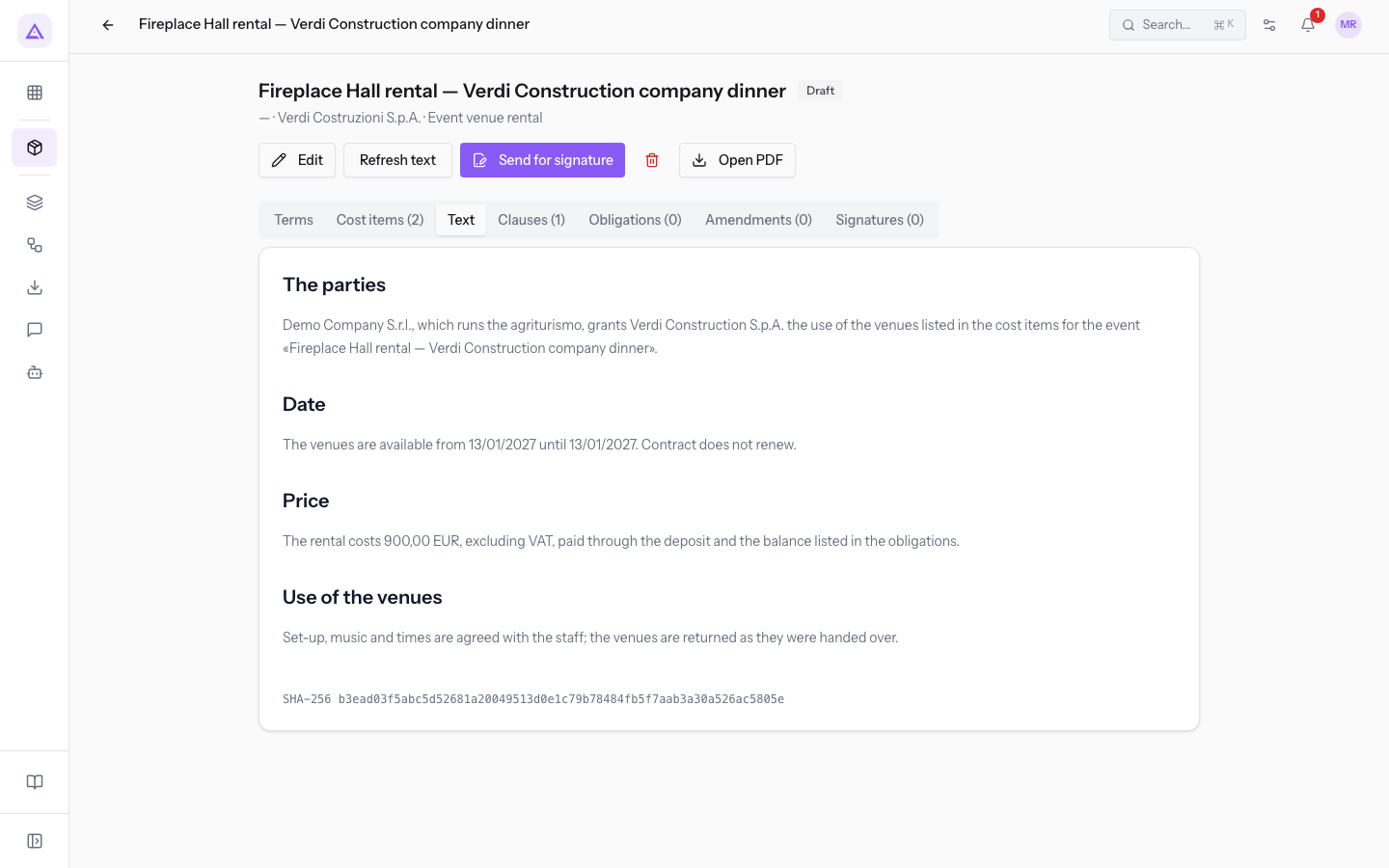
Refresh text regenerates the text from the template with the current contract data. The message Text refreshed appears.
The button is needed after correcting the template in Contracts › Settings: an edited template applies only to new contracts and to drafts regenerated after the change. After Save in the Edit contract window, or after a change to the cost items, the text regenerates by itself.
Note: Refresh text is available only on drafts. On sending, the text is regenerated one last time and then frozen.
To see the document as the counterparty will receive it, press Open PDF.
See it on your company, not on a slide deck.
In 30 minutes we map the software you use today.We show you how much work and how much margin Archimedes gives back.
Show me on my business →What industry are you in?
One tap — it lets us prepare the demo around your world.
What tools do you use today?
Pick the ones you recognise — or just type them. It helps us show you how they migrate.
Last step: your details.
We reply within one working day — and right after, if you like, you pick the demo slot yourself.
We couldn't send your request. Try again, or write to us at [email protected].
By sending, you agree to your data being processed so we can get back to you about the demo. Privacy notice.
Preview form — nothing is sent from this page.
Want to schedule the demo now?
Your call: book the slot you prefer yourself, or we'll call you to arrange it.
Live availability, 30 minutes, instant confirmation. The calendar opens in a new tab.
Lock in your slot ↗We'll get back to you within one working day — and we'll join the call already knowing your world.
The calendar is open in another tab: pick a slot and the demo is booked. Can't see it? Reopen it ↗
Preview page: nothing was sent.
Our calendar is live: take the slot that suits you and the demo is booked. 30 minutes, instant confirmation, no waiting.
Lock in your slot ↗